

An assignment agreement is a legal document that transfers the rights and obligations of one party under an existing contract to a third party.
In most cases, rights under a contract are freely assignable unless the contract includes an anti-assignment clause or the assignment would materially change the duties or risks of the other contracting party.
What Is an Assignment Agreement?
When a party to a contract (the assignor) transfers their rights, benefits, or obligations under that contract to another person or entity (the assignee), that transfer is documented in an assignment agreement.
The original contracting party who is not involved in the transfer is called the obligor or obligee, depending on whether they owe a duty or are owed one. After a valid assignment, the assignee steps into the assignor's position and can enforce the contract rights directly against the obligor.
Assignment law is primarily governed by state common law and, for contracts involving goods, by UCC § 2-210, Delegation of Performance; Assignment of Rights. The Restatement (Second) of Contracts also provides widely followed guidance on what can and cannot be assigned.
How Contract Assignment Works
A contract assignment involves three parties, even though only two of them sign the assignment agreement:
a) Assignor: The original contracting party who transfers their contractual rights to the assignee. After a full assignment, the assignor generally gives up their right to enforce the contract against the obligor.
b) Assignee: The new party who receives the rights under the contract. The assignee steps into the assignor's shoes and can now enforce the contract against the obligor.
c) Obligor (the non-assigning party): The party who owes a duty under the original contract. The obligor is not a party to the assignment agreement itself, but must be notified of the assignment so they can perform their obligations to the correct party.
Unless the contract or applicable law requires obligor consent, the assignor and assignee can execute the assignment without the obligor's agreement. The obligor must then perform for the assignee instead of the assignor.
Note: Notice to the obligor is critical. Until the obligor receives notice of the assignment, they are protected if they continue performing for the original assignor. Once they receive notice, they must perform for the assignee or risk double liability.
Assignment vs. Novation: The Key Difference
Assignment and novation are often confused but serve fundamentally different purposes.
In short, an assignment moves rights without replacing the contract. A novation replaces the contract entirely and releases the original party. If your goal is to completely step out of a contract and have a third party take your place with the other party's full release, you need a novation, not an assignment.
Types of Assignment Agreements
1. Contract rights assignment: Transfers the right to receive the benefit of a contractual performance, such as payment under a service agreement or goods under a supply contract.
2. Lease assignment: Transfers a tenant's interest in a lease to a new tenant. See our Assignment and Assumption of Lease Agreement template. In most states, landlord consent is required unless the lease expressly permits assignment.
3. Intellectual property assignment: Transfers ownership of copyrights, patents, trademarks, or trade secrets. IP assignments often require recording with the USPTO Assignment Center or the U.S. Copyright Office Recordation portal to be enforceable against third parties. See our Copyright Assignment and Trademark Assignment templates.
4. Insurance policy assignment: Transfers the right to receive insurance proceeds to a third party, commonly used in mortgage and financing contexts.
5. Real estate contract assignment: Transfers the right to purchase real estate under a signed purchase agreement, frequently used in wholesale real estate transactions.
6. Assignment of LLC interest: Transfers membership interest in an LLC, subject to the operating agreement's transfer restrictions. Check out our Assignment of LLC Interest template.
When Can a Contract Be Assigned?
Under Restatement (Second) of Contracts § 317, a contractual right can generally be assigned unless assignment would:
- Materially change the duty of the obligor
- Materially increase the burden or risk imposed on the obligor
- Materially impair the obligor's chance of obtaining return performance
- Materially reduce the value of the return performance to the obligor
In practice, most commercial contract rights are assignable. Rights that are typically not assignable without consent include:
Personal service contracts: Contracts where performance depends on the unique skills or character of the original party, such as an artist or professional athlete.
Government contracts: Federal contracts are subject to the Anti-Assignment Acts — 41 U.S.C. § 6305 and 31 U.S.C. § 3727 — which generally prohibit assignment of government contracts without agency consent.
Contracts with explicit anti-assignment clauses: If the contract says "this agreement may not be assigned without the written consent of all parties," that clause will generally be enforced.
Future rights that have not yet arisen: Courts in some jurisdictions will not enforce assignments of rights that do not yet exist, though UCC Article 9 provides significant exceptions for commercial contexts.
Anti-Assignment Clauses: What They Mean
An anti-assignment clause prohibits one or both parties from assigning their rights under a contract without the other party's consent. These clauses are common in commercial leases, service agreements, and software licenses.
Not all anti-assignment clauses are absolute. Courts distinguish between clauses that:
Void the assignment: The assignment is automatically invalid if made without consent. Courts in most states enforce this type of clause.
Give the non-assigning party a right to terminate: The assignment is technically valid, but the non-assigning party can terminate the contract in response. Some courts limit this to cases where the other party actually exercises the termination right.
Require notice but not consent: The assignment can proceed, but the non-assigning party must be notified within a specified time.
Note: If an anti-assignment clause covers only "assignments" and not "delegations," courts may hold that obligations can still be delegated even if rights cannot be assigned. Always read the clause carefully and consult an attorney if in doubt.
Create Your Assignment Agreement Today
Get a legally compliant assignment agreement template with the correct consent requirements and transfer language for your state.
What to Include in an Assignment Agreement
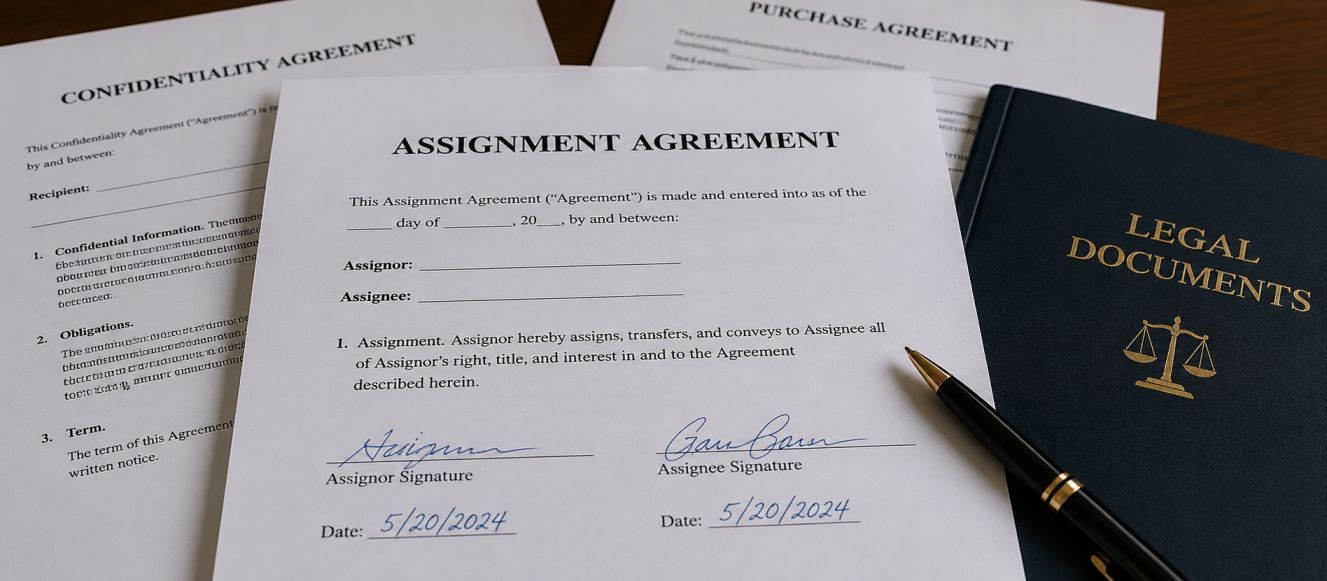
1. Identification of parties: Full legal names and addresses of the assignor and assignee. The obligor is typically not a party to this agreement but should be identified by name.
2. Reference to the original contract: The date, parties, and subject matter of the original contract being assigned. Attach a copy if possible.
3. Description of what is being assigned: Specify whether rights only, obligations only, or both are being transferred. If partial, describe what portion.
4. Representations and warranties: The assignor should represent that they have the right to assign the interest, that no prior assignment has been made, and that the contract is in good standing.
5. Consideration: The payment or other value exchanged for the assignment. Even a nominal amount should be stated to ensure the agreement is supported by consideration.
6. Effective date: The date on which the assignment takes effect. This may be the signing date or a future date.
7. Assumption of obligations: If the assignee is assuming the assignor's obligations under the original contract, this should be expressly stated. Without this language, the assignee may receive rights without taking on duties.
8. Indemnification: Specifies who is responsible for obligations arising before vs. after the effective date of the assignment.
9. Notice requirement: States how and when the obligor will be notified of the assignment.
10. Governing law: Identifies which state's law governs the assignment agreement.
11. Signatures: Both the assignor and assignee must sign. In many states, the agreement must also be witnessed or notarized if the underlying contract requires it.
How to Assign a Contract: Step by Step
- Review the original contract for anti-assignment clauses, required notice provisions, and any conditions on assignment.
- Obtain any required consent from the obligor or other parties to the original contract before executing the assignment.
- Draft the assignment agreement identifying the parties, the original contract, and what rights and/or obligations are being transferred.
- Exchange consideration between the assignor and assignee.
- Both parties sign the assignment agreement. Have it notarized if required by the underlying contract or applicable state law.
- Provide written notice of the assignment to the obligor, including the assignee's name, contact information, and the effective date.
- Deliver copies of the executed assignment agreement to all relevant parties and retain originals in a secure location.
- If the assignment involves intellectual property, file with the USPTO's Transferring Ownership portal for patents and trademarks, or the U.S. Copyright Office for copyrights.
What Happens After Assignment
Once a valid assignment is complete and the obligor has received notice, the following rules generally apply:
a) Assignee can enforce directly: The assignee now has the right to demand performance from the obligor and can sue to enforce the contract if the obligor fails to perform.
b) Assignor may retain secondary liability: Unless the contract or a subsequent novation releases the assignor, they may remain secondarily liable if the assignee fails to perform assumed obligations. The original lease assignor, for example, is often still liable to the landlord if the new tenant defaults.
c) Obligor's defenses are preserved: The obligor can raise against the assignee any defense they would have had against the assignor, including breach of contract, failure of consideration, or fraud.
d) Set-off rights may apply: If the obligor had a right to set off a claim against the assignor before receiving notice of the assignment, that right generally survives against the assignee.
Common Mistakes in Contract Assignment
a) Not reviewing the original contract first: Assigning a contract that contains a valid anti-assignment clause can void the assignment and expose the assignor to a breach of contract claim.
b) Failing to notify the obligor: Without notice, the obligor has no duty to perform for the assignee and is protected if they continue paying the assignor.
c) Confusing assignment with delegation: Assignment transfers rights; delegation transfers duties. Some contracts permit assignment but not delegation of performance obligations.
d) Not specifying whether obligations are assumed: If the assignment agreement does not address whether the assignee assumes the assignor's obligations, courts will look to the language of the agreement and applicable state law, with inconsistent results.
e) Skipping consideration: An assignment without consideration may be revocable by the assignor unless it is in writing and under seal in states that still recognize that formality.
f) Forgetting to record IP assignments: An unrecorded patent or trademark assignment may be void against a subsequent good-faith purchaser who records first. File promptly with the USPTO Transferring Ownership FAQs page for guidance on the recordation process.
Bibliography
- Restatement (Second) of Contracts — American Law Institute
- UCC § 2-210 — Delegation of Performance; Assignment of Rights — Cornell LII
- 41 U.S.C. § 6305 — Prohibition on Transfer of Contract — Cornell LII
- 31 U.S.C. § 3727 — Assignments of Claims — Cornell LII
- UCC Article 9 — Secured Transactions — Cornell LII
- USPTO Assignment Center
- USPTO — Patents Assignments: Change & Search Ownership
- USPTO — Transferring Ownership/Assignments FAQs
- U.S. Copyright Office — Recordation of Transfers
Disclaimer: This guide is for general informational purposes only and does not constitute legal advice. Laws vary by state and jurisdiction and may change without notice. Consult a licensed attorney for advice specific to your situation. Check your state's requirements before finalizing any legal document.