
A directors' resolution is a written record of a formal decision made by a corporation's board of directors, used to document and authorize actions like opening a bank account, issuing stock, or approving a major contract. It matters because many banks, lenders, and government agencies won't accept a corporate action as valid without one on file. This guide covers what a directors' resolution must include, how to draft one correctly, and when your business actually needs one.
How Directors' Resolutions Work
A directors' resolution is the formal paper trail proving the board approved a specific action, on a specific date, with the required level of support. Under most state corporation statutes, the board, not individual officers or shareholders, manages the business and affairs of the company. The resolution is how that authority gets exercised on the record.
Two ways a resolution is adopted:
What controls the process: State law sets the baseline rules for quorum percentages, meeting notice periods, and whether less-than-unanimous written consent is permitted. Your company's specific bylaws and articles of incorporation can set stricter requirements. Always check your governing documents first.
What makes a resolution legally effective: Procedural correctness, not complexity. A resolution does not need to be lawyer-drafted to be valid. In most cases, it is valid as long as it accurately reflects what the board actually approved, was adopted through the proper process, and is signed by the appropriate directors or officer.
When a Directors' Resolution Is Needed

Not every board decision requires a formal resolution, but certain actions typically do because a bank, government office, or counterparty will ask to see written proof of board approval before proceeding.
For small and growing corporations:
- Opening or changing signers on a corporate bank account (banks routinely require a directors resolution before adding or removing an authorized signer)
- Authorizing an officer to sign a loan, lease, or major vendor contract on the company's behalf
- Approving the issuance of new stock or amending stock ownership
- Appointing or removing officers, or setting officer compensation
- Approving a merger, acquisition, or sale of substantially all company assets
For established companies and boards:
- Declaring or approving dividends
- Approving annual budgets or major capital expenditures
- Adopting or amending corporate bylaws
- Authorizing the company to enter litigation or settle a dispute
- Documenting approval for regulatory or compliance filings the company chooses to make
On that last point: it's worth noting that as of a FinCEN final rule effective August 14, 2026, U.S.-formed companies and U.S. persons are now permanently exempt from Corporate Transparency Act beneficial ownership information (BOI) reporting to FinCEN; only foreign entities that register to do business in the U.S. still have a BOI filing obligation.
This reverses the earlier 2024 rule that required domestic companies to file. If your board previously passed a resolution authorizing an officer to handle BOI compliance, you generally do not need a new one to file, since domestic companies are no longer required to file at all, though many boards still keep a resolution on file authorizing an officer to monitor compliance obligations generally.
What a Directors' Resolution Must Include
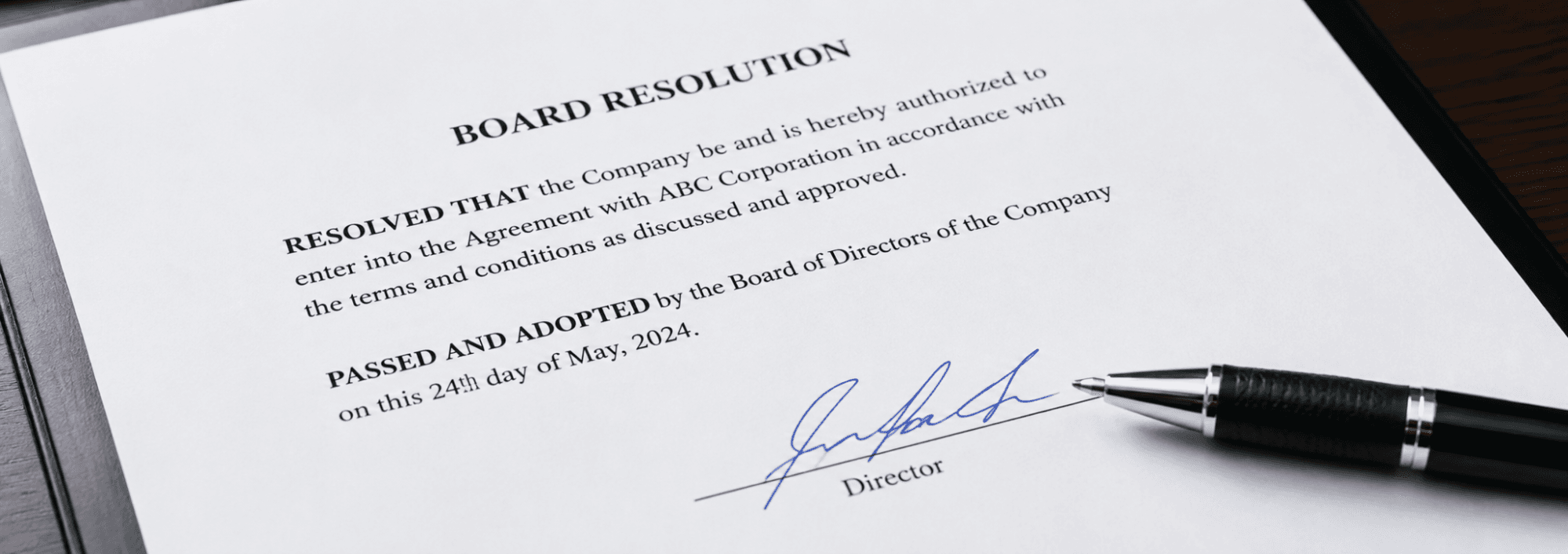
Every enforceable resolution generally needs the same structural backbone, regardless of state or industry. Skipping any of these tends to be wis oftenr counterparty rejects the document outright.
Non-negotiables:
- The corporation's exact legal name and state of incorporation
- A clear statement that this is a resolution of the board of directors (not shareholders or officers)
- The date of the meeting or the date written consent was signed
- A “WHEREAS” or background clause stating why the action is being taken
- A “RESOLVED” clause stating precisely what the board approved, in unambiguous language
- The names, titles, and signatures of the directors approving the resolution
- A statement of quorum or unanimous consent
Clauses that prevent disputes or rejection:
- Effective date language: specify exactly when the resolution takes effect, especially if it's not the same day it's signed, to avoid disputes about timing.
- Scope-limiting language: if you're authorizing an officer to sign a specific contract, name the contract, the counterparty, and any dollar limits, rather than granting open-ended authority.
- Certification statement: many banks and title companies want a line certifying that the resolution is a true and accurate record of board action and remains in effect.
- Corporate seal or attestation: some states and counterparties still expect this even though it's rarely legally mandatory anymore.
- Superseding-resolution language: if this resolution replaces an earlier one, say so explicitly so there's no ambiguity about which version controls.
Create Your Directors' Resolution
Protect your corporation's authority with an attorney-vetted, state-specific directors' resolution that banks and lenders will accept.
How to Draft a Directors' Resolution (Step by Step)
- Step 1: Identify the exact action being approved. Vague resolutions are typically rejected by banks and can create governance headaches later. Be specific: what, who, how much, and by when.
- Step 2: Confirm the approval method. Will this go through a formal board meeting with minutes, or will directors sign written consent instead? Check your bylaws first.
- Step 3: Draft the resolution using a standard director resolution format. Heading identifying the company and the board, one or more “WHEREAS” clauses for context, one or more “RESOLVED” clauses stating the decision, and a signature block.
- Step 4: Circulate the draft to all directors before signing. Directors generally need a fair opportunity to review the actual language, not just a summary of what's being approved.
- Step 5: Collect signatures. Depending on your bylaws and state, this may require every director's signature or just a quorum's vote recorded in meeting minutes.
- Step 6: File it with your corporate records. Keep the signed resolution with your minute book so it's easy to produce if a bank, auditor, or investor asks for it later.
- Step 7: Distribute certified copies as needed. Provide a certified copy rather than the original, and keep the signed original in your permanent file.
Using 360 Legal Forms, you can generate a directors resolution form through a guided questionnaire covering all 50 states, customize the specific clauses your situation needs, and sign and download it the same day.
Directors' Resolution vs. Written Consent vs. Board Meeting Minutes
These three terms get used almost interchangeably by non-lawyers, but they're not quite the same thing, and mixing them up is one of the more common sources of confusion for first-time corporate secretaries.
In practice, if your board rarely meets in person, a directors' consent in lieu of a meeting is often the more practical route. If your company is structured as an LLC rather than a corporation, an LLC resolution is the equivalent document for that entity type.
Is a Directors' Resolution Legally Binding?
Yes, in general, a properly adopted directors' resolution is legally binding on the corporation, provided it was approved through a valid process, is within the board's actual authority under the company's bylaws and articles of incorporation, and doesn't violate state law or the company's governing documents.
Electronic signatures on a directors' resolution are typically valid and enforceable in the United States. Under the federal Electronic Signatures in Global and National Commerce Act (ESIGN Act), a signature or record generally cannot be denied legal effect solely because it's in electronic form. Most states have also adopted their own version of the Uniform Electronic Transactions Act. That said, a resolution can still be challenged if it wasn't actually approved by a quorum or exceeded the board's authority.
Common Mistakes to Avoid

- Using vague or overly broad authorization language. “The board authorizes the CEO to run the business” is not a resolution a bank will accept for anything specific.
- Forgetting to specify the effective date. This can create real disputes if a transaction's timing later matters.
- Skipping quorum or unanimous consent requirements. Verbal agreement generally isn't enough; the resolution needs to reflect a properly conducted vote or signed consent.
- Not keeping a copy in the corporate records. A resolution that exists only in someone's email inbox is much harder to produce later.
- Citing outdated compliance requirements. Such as referencing domestic BOI filing obligations that no longer apply after the 2026 FinCEN rule change.
- Confusing a resolution with meeting minutes. Assuming one document automatically satisfies both purposes.
- Failing to have the resolution signed by directors with actual authority. Such as a resolution signed only by officers when board approval is what's actually required.
Conclusion
A directors' resolution is one of the simplest documents a corporation can maintain, and one of the most consequential to get right. In most cases, it is the single piece of paper that banks, lenders, and business partners rely on to confirm your company had the authority to act. Without it, legitimate corporate decisions can be delayed, disputed, or rejected entirely.
Getting it right does not require legal expertise. It requires the correct structure, the right language for your specific situation, and a properly documented approval process that matches your bylaws and state requirements. A well-drafted resolution protects the company, the directors who signed it, and the counterparties relying on it.
Create My Directors' Resolution
Use the 360 Legal Forms directors' resolution template to create a state-specific, attorney-vetted document in minutes, without the cost or delay of starting from scratch.
Disclaimer: This guide is for general informational purposes only and does not constitute legal advice. Corporate governance requirements vary by state and by company. Consult a licensed attorney for advice specific to your situation.