
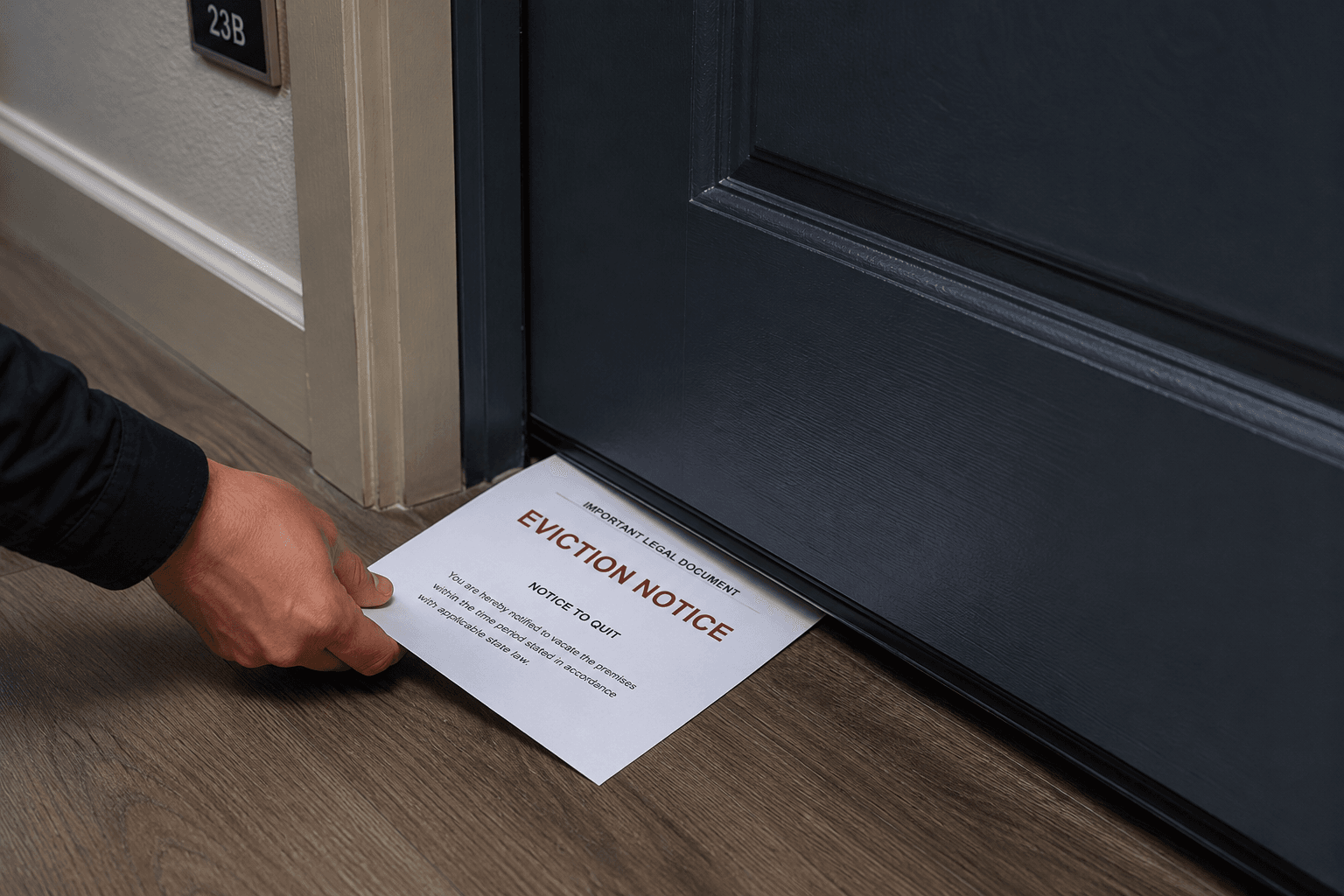
An eviction notice is a written legal document a landlord uses to notify a tenant that their tenancy is being terminated, and why. It is the required first step before any court action can begin. Receiving one does not mean you will be forced out immediately. Serving one does not mean the case is decided. Deadlines differ by state, notice requirements shift, and one small mistake can void the entire process. Start here and skip the guesswork.
Who Can Issue an Eviction Notice?
- Landlords and property owners: The property owner or their authorized representative can issue a notice to a tenant.
- Property management companies: When a management company acts on behalf of the owner, the notice should identify both the management company and the property owner.
- Sublessors: In sublease arrangements, the original tenant acting as sublessor can issue a notice to their subtenant, typically following the same rules as a standard landlord-tenant relationship.
Who Is Involved in the Eviction Process?
Types of Eviction Notices
The type of notice a landlord must use depends on the reason for the eviction. Using the wrong notice type is one of the most common causes of an eviction case being dismissed in court.
Pay Rent or Quit Notice
Used when a tenant has failed to pay rent. It gives the tenant a set number of days, typically 3 to 14 depending on the state, to pay the full amount owed or vacate the property. If the tenant pays in full within the deadline, the eviction process stops in most states. Accepting a partial payment can legally reset the clock in many jurisdictions, so landlords should be cautious about doing so without written agreement.
- Common deadlines by state:
Note: You can check your state to see how the notice period varies by state.
- What it must include: The exact dollar amount owed, the due date, the payment deadline, and instructions for how and where to pay
Cure or Quit Notice (Notice to Perform Covenant or Quit)
Used when a tenant has violated a term of the lease other than nonpayment of rent, such as having an unauthorized pet, subletting without permission, or causing a noise violation. It gives the tenant a set number of days to correct (cure) the violation or vacate. If the tenant cures the violation within the deadline, the eviction process generally stops.
- Common deadline: 3 to 10 days depending on state and lease terms
- What it must include: A specific description of the lease clause violated and exactly what the tenant must do to cure it. Landlords may also want to issue a Notice of Lease Violation before escalating to a formal eviction notice.
Unconditional Quit Notice
The most serious type. It requires the tenant to vacate with no option to pay or correct any issue. Typically reserved for the most serious situations and in most states is only permissible for specific statutory reasons.
- When it applies: Repeated nonpayment (tenant has already received multiple Pay or Quit notices), serious property damage, illegal activity on the premises, repeated lease violations after prior notice, or subletting without permission in states that treat it as an unconditional ground
- Common deadline: 3 to 10 days, depending on the state and the specific ground cited
No-Cause Termination Notice (Notice to Vacate)
Used to end a month-to-month tenancy without the landlord citing any specific tenant wrongdoing. The landlord is not required to give a reason, but must give sufficient advance notice. This type of notice is increasingly restricted in states with just-cause eviction laws (see Section 7). In states without just-cause requirements, no-cause notices are generally permitted as long as the termination is not retaliatory or discriminatory.
- Common deadline: 30 days for tenants under one year; 60 days for tenants over one year (California); 30 days (Texas, Florida, Illinois); 90 days in some rent-controlled areas
Reasons to Send an Eviction Notice
- Nonpayment of rent: The most common reason. Most states allow a landlord to begin the eviction process as soon as rent is one day late, though many landlords wait until after any grace period in the lease has expired.
- Consistent late payment: In most states, a pattern of chronically late payments qualifies as a lease violation even if rent is eventually paid. Check your state's law before relying on this ground.
- Unauthorized occupants: A tenant who allows an unlisted person to move in, or who sublets without the landlord's permission, has typically violated the lease.
- Unauthorized pets: If the lease prohibits pets and a tenant brings one in, a Cure or Quit notice is typically appropriate. This is generally curable by removing the pet.
- Property damage: Damage beyond normal wear and tear gives the landlord grounds for an eviction notice. In serious cases, an Unconditional Quit may be appropriate.
- Illegal activity: Most states allow landlords to serve an Unconditional Quit notice for drug activity, criminal offenses, or other illegal conduct on the premises, often with a shorter notice period.
- Nuisance or disturbances: Repeated noise complaints, harassment of neighbors, or other conduct that materially interferes with other tenants can justify a Cure or Quit or, if repeated, an Unconditional Quit.
- End of lease or tenancy: When a fixed-term lease ends and the landlord does not intend to renew, or when a month-to-month tenancy is being terminated, a No-Cause Termination Notice is used.
- Owner move-in or property sale: In several states, a landlord who intends to move into the unit or sell the property must give extended notice, typically 60 to 90 days, and in some jurisdictions must pay relocation assistance.
What to Include in an Eviction Notice
A legally defective eviction notice will be dismissed in court, forcing the landlord to restart the entire process. Every state has minimum requirements, but the following elements are required in virtually all jurisdictions. Landlords should ensure that the eviction notice references the same terms as in their Residential Lease Agreement.
Required Elements
- Tenant's full name and rental address: Use the name(s) exactly as they appear on the lease. Include the full rental address with the unit number. If there are multiple tenants, list all of them.
- Date the notice is served: The notice period clock typically starts on the day the notice is delivered, not the day it was written. Using the correct served date is critical.
- Type of notice and basis for it: Clearly identify whether this is a Pay or Quit, Cure or Quit, Unconditional Quit, or Termination Notice. State the specific lease clause violated or the statutory basis for the action.
- Exact amount owed (for Pay or Quit notices): List the specific months of unpaid rent, the monthly amount, any applicable late fees if permitted by state law, and the total sum due. Do not include amounts in dispute or fees not allowed under your state's law.
- Specific cure required (for Cure or Quit notices): Describe the violation clearly and tell the tenant exactly what action will cure it. Vague descriptions are commonly used to defeat eviction cases in court.
- Deadline to comply: State the exact date by which the tenant must pay, cure, or vacate. Count the days carefully and know whether your state counts calendar days or business days.
- How and where to pay or submit cure: For Pay-or-Quit notices, specify the payment method and location. For Cure or Quit notices, specify how the tenant should document compliance.
- Landlord's name and contact information: The notice must identify the landlord or property manager and include an address or phone number for communication.
- Signature: The landlord or authorized agent must sign the notice. Some states require the notice to identify whether the signer is the owner, manager, or attorney.
Does an Eviction Notice Need to Be Notarized?
In most states, eviction notices do not require notarization. Notarization is generally not required for a notice to be legally valid. The document must be signed by the landlord or their authorized agent, but a notary seal is not a standard requirement.
The exception is when the notice is incorporated into a sworn affidavit for court filing purposes. Some states require sworn affidavits of service, in which the person who served the notice swears under oath to the manner and date of delivery. That affidavit may require notarization. But the notice itself generally does not.
Create a State-Ready Eviction Notice Today
Get a legally compliant eviction notice template with the correct notice period and required language for your state.
How to Serve an Eviction Notice
Serving the notice correctly is just as important as writing it correctly. An eviction notice delivered by an improper method may be deemed invalid in court, even if its contents are legally perfect. Methods vary by state, and some states require specific methods depending on the type of notice.
Acceptable Service Methods
- Personal delivery to the tenant: Physically handing the notice to the tenant or, in many states, to any person of suitable age and discretion at the rental address. This is the most reliable method because the delivery is direct. Document the date, time, and identity of the person who received it.
- Substituted service (posting and mailing): If the tenant is not home and personal delivery cannot be accomplished after a reasonable attempt, most states allow the landlord to post the notice conspicuously on the front door and mail a copy by first-class or certified mail. This method is sometimes called "nail and mail." The notice period typically begins on the date of posting or mailing, not on the date the tenant reads it.
- Certified or registered mail: Some states accept certified mail as a standalone method. Certified mail creates a paper trail, but the notice period may not begin until the tenant signs for it, or after a set number of days, depending on state law. Confirm which rule applies before relying on mail alone.
- Sheriff or process server: In some states, particularly for Unconditional Quit notices or formal unlawful detainer proceedings, service by a licensed process server or sheriff's deputy is required or strongly recommended. This is the strongest method for court purposes.
Service by State: Key Rules
Documenting Service
Always document how, when, and where you served the notice. Best practices include:
- Take a photograph of the posted notice on the door with a timestamp if using the nail-and-mail method
- Keep the certified mail receipt and the return receipt (green card) if the tenant signs for it
- Write a brief written record of personal delivery, including the date, time, and name of the person you handed it to
- In states that allow a process server, obtain a signed proof-of-service affidavit
Eviction Notices by Notice Period: State-by-State Table
Notice periods are the minimum number of days a landlord must give before filing an eviction lawsuit. Sending the wrong notice period, even by one day, generally invalidates the notice and requires the landlord to start over.
Note: Notice periods are minimums. Always verify current requirements with your state's official DMV or housing court website before serving notice. Check your state's requirements before finalizing.
Just-Cause Eviction States: Where Landlords Must Have a Reason
Most states allow landlords to end a month-to-month tenancy without giving any reason, as long as they give proper advance notice. In a growing number of states, however, landlords must have a legally recognized "just cause" before they can terminate a tenancy, regardless of lease type.
States With Just-Cause Eviction Requirements
-
California: AB 1482 (Tenant Protection Act) requires just cause for tenants who have lived in a covered unit for 12 months or more. Qualifying causes include nonpayment, lease violations, criminal activity, and owner move-in. Many local jurisdictions (Los Angeles, San Francisco, Oakland) have additional or stricter protections.
-
Oregon: Senate Bill 608 (2019) was the first statewide just-cause eviction law, effective February 28, 2019. Landlords generally cannot terminate a fixed-term tenancy early or a month-to-month tenancy without one of the recognized statutory grounds.
-
Washington: Requires just cause for all evictions of residential tenants. Accepted grounds include nonpayment, lease violations, owner move-in, and property demolition.
-
New Jersey: The Anti-Eviction Act (N.J.S.A. 2A:18-61.1) covers most residential tenants and requires a documented just cause for eviction, including nonpayment, disorderly conduct, willful damage, and the end of the lease due to nonrenewal.
-
Washington, D.C.: Requires just cause and, in many cases, entitles tenants to relocation assistance.
-
Maryland (Baltimore City): Local just-cause protections apply in certain jurisdictions.
In just-cause states, a no-cause eviction notice is generally void from the start. Landlords in these states who issue a no-cause notice face having the case dismissed and potentially owing the tenant damages for an improper eviction. Check your state's requirements before finalizing.
Next Steps After Serving the Eviction Notice
If the Tenant Complies
If the tenant pays rent in full (for a Pay or Quit notice), cures the lease violation (for a Cure or Quit notice), or vacates (for any notice type) within the deadline, the eviction process generally ends. The landlord should document compliance in writing and confirm in a brief written note that the matter has been resolved and the tenancy continues, if applicable.
If the Tenant Does Not Comply
If the tenant neither complies nor vacates by the end of the notice period, the landlord's next step is to file an eviction lawsuit. This proceeding goes by different names in different states:
- Unlawful Detainer: Used in California, Florida, and many other states
- Forcible Entry and Detainer (FED): Used in Texas, Ohio, Colorado, and others
- Summary Possession or Summary Ejectment: Used in North Carolina and several other states
- Dispossessory: Used in Georgia
The landlord files a complaint with the appropriate local court (often housing court or general district court) and pays a filing fee, typically ranging from $50 to $200. The court then schedules a hearing and the tenant is formally served with a court summons.
At the Court Hearing
Both parties present their case before a judge or magistrate. The landlord must show that the notice was properly served, that the notice period has expired, and that the tenant failed to comply. The tenant may raise any of the following defenses:
- The notice was defective (wrong type, wrong period, improper service)
- The rent was paid within the deadline
- The landlord accepted payment after the notice, waiving the right to evict
- The eviction is retaliatory (tenant filed a complaint and landlord is responding with eviction)
- The eviction is discriminatory under the Fair Housing Act
- The landlord failed to maintain habitable conditions (implied warranty of habitability)
If the Landlord Wins
The court issues a judgment for possession. The landlord receives a writ of possession, and law enforcement (typically the county sheriff) can physically remove the tenant if they do not leave voluntarily. The landlord may also receive a money judgment for unpaid rent and court costs.
If the Tenant Wins
The eviction case is dismissed and the tenant may remain. If the eviction was found to be retaliatory or discriminatory, the landlord may owe damages. An improper eviction notice is the most common reason cases are dismissed at this stage.
Tenant Rights When Receiving an Eviction Notice
 Receiving an eviction notice does not mean the process is over or that the tenant has no options. Federal law and state landlord-tenant statutes provide significant protections that remain in place throughout the eviction process.
The Right to the Full Notice Period
A landlord cannot lock a tenant out, shut off utilities, or remove belongings before the notice period expires and a court order has been obtained. Any such action constitutes illegal self-help eviction. Tenants who experience self-help eviction may be entitled to damages including actual damages, civil penalties, and in some states, punitive damages.
The Right to Cure
For Pay-or-Quit and Cure-or-Quit notices, the tenant generally has the right to remedy the problem within the notice period to stop the eviction. If the tenant pays in full or cures the violation, the landlord is typically required to accept it and the tenancy continues. Document cure in writing.
The Right to Contest the Eviction in Court
A tenant may always contest an eviction by appearing at the court hearing and raising valid defenses. Common successful defenses include a defective notice (wrong period, improper service, or wrong notice type), retaliation for exercising a legal right, waiver (landlord accepted rent after serving notice), and uninhabitable conditions.
Anti-Retaliation Protection
In virtually every state, a landlord cannot serve an eviction notice in retaliation for a tenant's protected activity, such as filing a habitability complaint, organizing tenants, contacting code enforcement, or exercising a lease right. Most states create a legal presumption of retaliation if an eviction notice is served within 60 to 180 days of a tenant exercising a protected right.
Anti-Discrimination Protection
Under the federal Fair Housing Act, a landlord cannot evict a tenant based on race, color, national origin, religion, sex, familial status, or disability. Many states and localities add additional protected classes such as source of income, sexual orientation, and immigration status. An eviction notice served on discriminatory grounds is void.
Can an Eviction Notice Be Challenged or Disputed?
Yes. A tenant can challenge an eviction notice in several ways: by complying within the notice period (if curable), by communicating directly with the landlord to negotiate an alternative resolution, by seeking free legal help from a tenant legal aid organization, or by appearing in court and presenting a defense. The strongest challenges stem from procedural defects in the notice itself: the wrong notice type, the wrong notice period, improper service, or missing required content.
Send a Legally Correct Eviction Notice
Use a state-specific template with the correct notice period, required language, and service instructions already built in.
Can I Use an Eviction Notice Without a Written Lease?
Yes. A written lease is not required for a tenancy to exist or for an eviction to be legally initiated. When a tenant pays rent and a landlord accepts it without a written lease, an implied or oral month-to-month tenancy generally exists under state law. The landlord may still serve an eviction notice, but the applicable rules are those for month-to-month tenancies in that state.
The absence of a written lease can complicate the landlord's case in court if the eviction is based on a lease violation, since the landlord must establish what terms the oral tenancy included. For nonpayment of rent, the absence of a written lease generally does not affect the landlord's right to evict, as long as the proper notice type and period are used.
Disclaimer: 360 Legal Forms is not a law firm and does not provide legal advice. This guide is for general informational purposes only. Laws vary by state and locality. Consult a licensed attorney for advice specific to your situation.
Bibliography