
Nonprofit bylaws are the internal rulebook that tells your board how to run the organization: how directors are elected, how meetings work, who can vote, and who has authority to spend money. Every state expects a nonprofit corporation to operate under some form of bylaws, and the IRS looks closely at them when it reviews your 501(c)(3) application. Get them right and your board runs smoothly for years; get them wrong , or skip them , and you're setting up disputes, delays, and compliance headaches down the road.
How Nonprofit Bylaws Work Legally
Bylaws are what lawyers call a "governing document." They sit alongside your articles of incorporation, but they do a different job. The articles create the corporation in the eyes of the state. The bylaws tell the people running it how to actually operate it day to day.
- State law governs bylaws, not federal law. Texas, for example, spells this out directly: under the Texas Business Organizations Code's bylaws provision, a nonprofit's initial bylaws are adopted by its board of directors (or by its members if member-managed), and the board generally has ongoing authority to amend or repeal them unless the certificate of formation says otherwise. Most states follow a similar structure, though specific default rules vary , check your own state's nonprofit corporation act before finalizing language.
- Bylaws are typically not filed with the state. Unlike articles of incorporation, bylaws generally stay in the organization's own internal records. The Texas Secretary of State's nonprofit FAQ confirms: the state "does not maintain the bylaws or tax exempt filings of any nonprofit organization." The same is true in most other states. Bylaws only tend to surface publicly if attached to your IRS exemption application or if state disclosure rules require sharing them on request.
- The IRS is hands-off about specific wording. IRS guidance on exempt organization bylaws states that federal tax law does not require specific language in the bylaws of most organizations, though state law may require nonprofit corporations to have bylaws. What the IRS cares about is whether functioning governance rules are in place and whether certain provisions show up somewhere in your organizing documents.
Does a Nonprofit Need Bylaws? Who Needs Them and When

- Brand-new 501(c)(3) applicants: the IRS's Form 1023 application generally asks you to describe your organizing structure and, if you've adopted bylaws or other rules of operation, to attach them. Reviewers look for basic governance provisions even before your first board meeting happens.
- Existing nonprofits updating governance: if your nonprofit has been running on outdated or informal bylaws , or worse, none at all , a governance cleanup is often triggered by a new grant application, an audit, a board transition, or simply a founder realizing the rules were never written down.
- Nonprofits adding paid staff or an executive director: once you move from an all-volunteer board to a paid executive director, your bylaws need to clearly define that role's authority , especially financial and spending authority , so the board and staff aren't guessing where the line is.
- Nonprofits expanding their board: adding seats, creating committees, or changing how directors are nominated and removed all typically require a bylaws amendment, not just a board vote in the meeting minutes.
What Nonprofit Bylaws Must Include
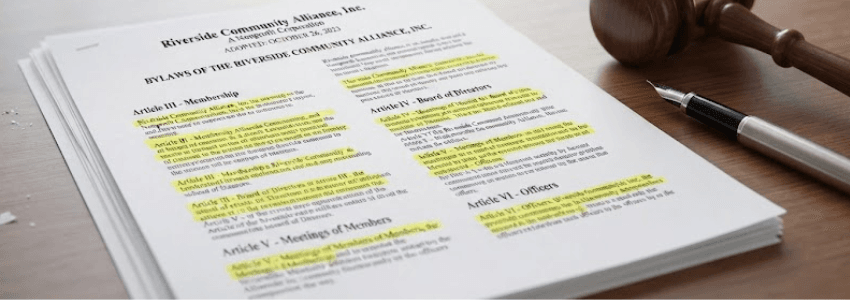
- Purpose: a restatement of the organization's mission, generally consistent with the purpose clause in the articles of incorporation.
- Board structure and size: minimum and maximum number of directors, qualifications, terms, and how vacancies are filled.
- Officer roles and duties: what the president, secretary, treasurer, and other officers are responsible for , and critically, the executive director's authority, including any dollar-amount limits on spending that require board approval above a certain threshold.
- Meeting, quorum, and voting rules: how often the board meets, how much notice is required, what quorum is needed to conduct business, and how votes are counted.
- Membership structure, if any: whether the nonprofit has voting members separate from the board, and if so, their rights and how they're admitted or removed.
- Amendment procedure: the specific process for amending the bylaws themselves.
- Conflict of interest policy: procedures for disclosing and managing situations where a director or officer's personal or financial interests might conflict with the organization's interests.
- Indemnification: protection for directors and officers acting in good faith on behalf of the organization.
- Dissolution clause: what happens to the organization's remaining assets if it ever closes down.
Provisions the IRS and state regulators look for during a 501(c)(3) or compliance review:
- A conflict of interest policy consistent with the sample policy in the Form 1023 instructions. Adopting it isn't strictly required for exemption, but the IRS asks about it directly on the application, and having one signals stronger governance.
- A dissolution clause that dedicates remaining assets to another 501(c)(3) exempt purpose, or to a government entity for a public purpose, which the organizational test under Section 501(c)(3) generally requires unless the state's own dissolution law already satisfies it.
- Evidence of a functioning, independent board rather than a single individual controlling all decisions.
- A documented process for how officer and executive director compensation is set and reviewed, since IRS Form 990 governance questions specifically probe this.
- Clear recordkeeping and reporting expectations tied to the organization's accounting period and tax year.
Executive director compensation and spending authority is a topic that deserves its own dedicated policy alongside the bylaws; a nonprofit compensation policy can spell out exactly how much an executive director can approve without board sign-off and how raises or bonuses get decided, which keeps the bylaws themselves cleaner and easier to amend
Create Your Nonprofit Bylaws
Get a complete, attorney-drafted nonprofit bylaws template that covers all required governance provisions for your 501(c)(3) organization.
Bylaws vs. Articles of Incorporation
Exact filing procedures and required contents vary by state, so always confirm your specific state's nonprofit corporation act before finalizing either document.
How to Create Nonprofit Bylaws (Step by Step)
Step 1: Gather your foundational documents.
Pull out your articles of incorporation, mission statement, and any notes from your founding board discussions, since your bylaws need to align with what's already on file with the state.
Step 2: Decide on board structure and size.
Set a minimum and maximum number of directors, term lengths, and how new directors are nominated and elected.
Step 3: Define officer roles and authority.
Spell out what the president, secretary, and treasurer do, and set clear spending authority limits for the executive director if the organization has one.
Step 4: Set meeting, quorum, and voting rules.
Decide how often the board meets, how much advance notice is required, what counts as a quorum, and whether votes need a simple majority or something higher for major decisions.
Step 5: Address membership structure, if applicable.
Decide whether the nonprofit will have voting members outside the board, and if so, define their rights.
Step 6: Add the required governance provisions.
Include a conflict of interest policy, an indemnification clause, and a dissolution clause that dedicates assets to another exempt purpose.
Step 7: Write the amendment procedure.
Specify exactly how future changes to the bylaws will be proposed, voted on, and adopted.
Step 8: Have the board formally adopt the bylaws.
This is typically done through a board vote recorded in the meeting minutes or memorialized with a corporate resolution, which creates a clean paper trail that the bylaws were properly approved.
Step 9: Store and distribute the final version.
Keep a signed copy in your permanent corporate records and make sure every director and relevant staff member has access to it.
Who Approves Nonprofit Bylaws, and How Often Should They Be Updated
The board of directors typically approves the initial bylaws through a formal vote at an organizational meeting. In a membership-based nonprofit, the members may hold some or all of that approval authority depending on how the organization is structured. That approval is usually documented in the meeting minutes , and many organizations formalize it with a written resolution so there's no ambiguity later about when and how the bylaws were adopted.
Amendments after that point generally follow whatever process the bylaws themselves specify, which commonly requires advance notice to directors, a quorum at the meeting, and sometimes a supermajority vote for significant changes.
How often to review: there's no single legal deadline in most states, but governance experts treat periodic review as standard practice. BoardSource's guidance on nonprofit bylaws recommends revisiting bylaws periodically to confirm they still reflect how the organization actually operates. As a practical rule of thumb, many organizations review their bylaws every two to three years, or immediately after any major structural change , such as adding an executive director, changing board size, or restructuring committees. It's also worth reviewing them whenever your board completes its annual Form 990, since several of that form's governance questions relate directly to policies your bylaws should already cover.
Get Nonprofit Bylaws Template
A complete, customizable nonprofit bylaws template covering board structure, officer roles, conflict of interest policy, and dissolution terms for 2026.
What Happens If a Nonprofit Doesn't Have Bylaws
Operating without bylaws, or with bylaws nobody has looked at in a decade, is rarely dramatic on day one. The problems tend to show up later:
- Exempt-status application problems: the IRS Form 1023 asks about your organizational structure and governance policies directly, and reviewers may follow up if your governance documentation looks thin or inconsistent, which can slow down or complicate your path to 501(c)(3) status.
- Governance disputes: without clear rules for how directors are elected, removed, or replaced , and how votes are counted , disagreements that would normally get resolved by checking the bylaws instead turn into prolonged board conflicts.
- Personal liability exposure for directors: directors generally owe the organization a fiduciary duty of care, which in practice includes acting in accordance with the organization's own governing documents. A board's failure to follow, or even have, proper governance procedures can support findings that directors failed to exercise reasonable diligence.
- Operational paralysis: without a defined quorum or clear officer authority, boards can find themselves unable to act at all, unsure whether a decision was validly made, or stuck with an underperforming officer they have no documented process for removing.
None of this means a missing bylaws provision automatically triggers a lawsuit or an IRS denial. But it does mean the organization is operating without the guardrails specifically designed to prevent these situations from escalating.
Common Mistakes to Avoid
- Copying a generic template without state-specific adjustments: a bylaws template written for one state's default rules may conflict with your own state's nonprofit corporation act on issues like quorum defaults or amendment authority.
- Leaving out a dissolution clause: this is one of the first things IRS reviewers check for on a 501(c)(3) application, and forgetting it can delay approval entirely.
- Leaving executive director spending authority vague: "the executive director manages day-to-day operations" isn't specific enough; without a dollar threshold, boards and staff end up guessing where approval is required.
- Skipping the conflict of interest policy: even though it isn't strictly mandatory for exemption, its absence is a red flag the IRS and outside auditors both notice.
- Setting quorum requirements that don't match board reality: a quorum set too high can paralyze a small or geographically spread-out board; set too low, it can let a handful of directors make major decisions unilaterally.
- Forgetting to include an amendment procedure: without one, it's unclear whether the bylaws can even be legally changed, or by whom.
- Never revisit the bylaws after the organization changes: bylaws written for an all-volunteer startup rarely still fit once the nonprofit has paid staff, multiple programs, or a much larger board.
Disclaimer: 360 Legal Forms is not a law firm and does not provide legal advice. The information in this guide is provided for general informational purposes only and should not be relied on as a substitute for advice from a licensed attorney. Nonprofit governance requirements vary by state and by an organization's specific circumstances, so consult a qualified attorney or tax professional before finalizing your bylaws or making decisions that affect your organization's legal or tax-exempt status.
Bibliography
- IRS - Exempt Organization: Bylaws
- IRS - Instructions for Form 1023
- IRS - Form 1023: Purpose of Conflict of Interest Policy
- IRS - Dissolution Provision Required Under Section 501(c)(3)
- IRS - About Publication 557, Tax-Exempt Status for Your Organization
- Texas Secretary of State - Nonprofit Organizations FAQs
- Texas Business Organizations Code, Chapter 22 - Nonprofit Corporations
- BoardSource - Nonprofit Bylaws