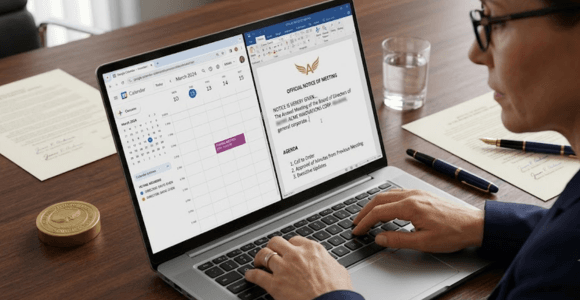
A notice of meeting is a written communication, sent by a corporation, LLC, nonprofit, or association to its directors, shareholders, or members, that tells them a meeting has been scheduled and gives them the date, time, place (or virtual link), and purpose. It's generally required before most formal board, shareholder, or member votes can be treated as valid, and getting the format or timing wrong is one of the more common ways a vote later gets challenged. This guide covers how notice of meeting requirements typically work, what to include, and how to avoid the mistakes that cause the most disputes.
How a Notice of Meeting Works
A notice of meeting is the formal, advance communication that tells the people entitled to attend a corporate or organizational meeting that it is happening and what it is about. It generally applies to corporations (notices to the board of directors and to shareholders), LLCs and nonprofits (notices to members), and other membership-based organizations such as homeowners' associations and trade groups.
What controls the requirement: In most cases, the obligation to give notice comes from three overlapping sources.
Board meetings vs. shareholder and member meetings: Notice requirements for board (director) meetings are generally looser than for shareholder or member meetings. Many state statutes leave the specific advance-notice period for board meetings almost entirely to the bylaws, sometimes requiring only "reasonable notice." Shareholder and member meeting notices are typically more tightly defined by statute.
Delaware's General Corporation Law requires that written notice of a stockholders' meeting generally be given not less than 10 nor more than 60 days before the meeting date, unless the certificate of incorporation or bylaws provide a different timeframe. Other states set their own defaults. Always check your specific state's business corporation act, nonprofit corporation act, or LLC act, and your own bylaws, before finalizing a notice.
It is also worth distinguishing a notice of meeting from two closely related documents: meeting minutes, which record what happened during the meeting after the fact, and a waiver of notice, which lets someone skip the notice requirement entirely by agreeing in writing, or by simply showing up, that they do not need it.
When a Notice of Meeting Is Needed and Who Can Issue It

- Annual board meetings: Most corporations hold at least one annual meeting of the board of directors to review the year, elect officers, and handle recurring governance matters, and an annual meeting notice is typically required even though the date is often set in advance in the bylaws.
- Annual shareholder meetings: Corporations with shareholders generally must send an annual meeting notice covering the election of directors and any other business, such as approving auditors or major transactions.
- Special board or shareholder meetings: A notice of special meeting is used any time a matter can't wait until the next regular meeting, such as an urgent financing decision, an executive change, or an emergency policy vote. Special meeting notices often must specifically state the purpose of the meeting, since business outside that stated purpose typically can't be transacted.
- Member meetings (LLCs, nonprofits, HOAs, associations): A notice of meeting of members works the same way for member-managed LLCs, nonprofit corporations, condo and homeowners' associations, and trade or membership associations. Annual, special, and even initial organizational member meetings generally require notice under the entity's governing documents.
- Committee meetings: Board committees (audit, compensation, nominating) may have their own notice requirements set out in the bylaws or committee charter, though these are often less formal than full board notice.
- Cancellation of a scheduled meeting: When a previously noticed meeting is called off or rescheduled, a cancellation notice is generally advisable, and sometimes legally required, so that all recipients are formally informed and no one shows up expecting a meeting that isn't happening.
Who can issue a notice of meeting depends on the entity's governing documents, but as a general rule, the authority to call and issue a notice belongs to the board chair, the corporate secretary, the president or CEO, or, in some structures, any group of directors or a percentage of shareholders or members acting together. Bylaws commonly designate the secretary as the officer responsible for actually preparing and sending the notice, even when someone else, like the board chair, has the authority to call the meeting itself.
What a Notice of Meeting Must Include
- Date of the meeting: the specific calendar date, stated unambiguously.
- Time of the meeting: start time, ideally an expected end time, and the time zone if participants span more than one.
- Place or virtual meeting link: a physical address, or, for a virtual or hybrid meeting, the platform name and a working access link or dial-in number.
- Agenda items or purpose of the meeting: for special meetings especially, most statutes and bylaws bar the group from voting on anything not disclosed in the notice.
- Notice period compliance: confirmation that the notice is being sent within whatever minimum and maximum window applies.
- Who is calling the meeting: the name and title of the person or body issuing the notice, so recipients can confirm it's authorized.
- Voting matters requiring special disclosure: if the meeting will vote on a merger, dissolution, bylaw amendment, or removal of a director, most states require that specific matter be spelled out in the notice itself.
Formatting and delivery details that prevent a meeting from being challenged:
- Use clear, unambiguous language: avoid vague phrasing like “sometime next month”; a notice should read like a business document, not an informal reminder.
- Send to the correct, current addresses: notices generally must go to the mailing or email address on file; an outdated address can, in some cases, invalidate notice to that recipient.
- Keep proof of delivery: retain a copy of the notice, the distribution list, and the date and method sent, since this record becomes evidence that proper notice was given if a decision is later challenged.
- Match the format to the audience: a notice for members of a large association may need broader posting in addition to direct mail, while a small private company board notice may be as simple as an email.
- State the record date, if applicable: for shareholder or member votes, the notice often needs to reference the record date used to determine who is entitled to vote.
- Include instructions for proxies or remote participation: if proxy voting or remote attendance is allowed, the notice should explain how to submit a proxy or connect remotely.
Create Your Notice of Meeting
Make sure your meeting is legally valid before it happens with a state-specific notice of meeting template. A properly formatted notice protects every vote taken at the meeting from being challenged on a technicality.
How Far in Advance Should a Meeting Notice Be Sent?
There's no single national rule for how far in advance a notice of meeting must go out, since timing is generally set by a combination of state statute and the organization's own bylaws. As a benchmark, Delaware's General Corporation Law sets a default stockholder meeting notice window of not less than 10 nor more than 60 days before the meeting, unless the certificate of incorporation or bylaws specify otherwise. Many other states use similar 10-to-60-day defaults for shareholder and member meetings, though this varies and should always be confirmed against your specific state's statute.
Board (director) meeting notice periods are typically shorter and more flexible than shareholder or member notice periods, often set by the bylaws at anywhere from 24 hours to a few days for a special board meeting, and sometimes described only as “reasonable notice” if the bylaws are silent. Special meetings generally allow shorter notice than annual meetings, precisely because they're meant to address time-sensitive matters, but the trade-off is that the notice must be scrupulous in disclosing the specific purpose of the meeting. When in doubt, send an important meeting notice earlier rather than later. Extra lead time rarely causes a problem, while insufficient notice is one of the most common grounds used to challenge a vote after the fact.
Notice Timing by Meeting Type
Waiver of Notice
Even when a state statute or bylaw requires formal notice, most jurisdictions also allow that requirement to be waived. Under Delaware law, for instance, a written waiver signed by the person entitled to notice, or a waiver sent by electronic transmission, is generally treated as equivalent to notice, whether it's signed before or after the meeting date stated in it. Just as importantly, simply showing up and participating in the meeting typically counts as a waiver of notice on its own, unless the person attends only to object, at the very start of the meeting, that it wasn't properly called.
This is genuinely useful in practice. New companies often hold their first organizational meeting before formal notice procedures are even set up, and a signed waiver of notice lets that meeting proceed without a defect. It's also common for small, closely held companies where all directors or shareholders already know about and agree to a meeting, in which case circulating a quick waiver is far simpler than tracking a formal notice period. Most states don't require the waiver to specify what business will be discussed, unless the bylaws say otherwise, though it's still good practice to attach an agenda for clarity.
Delivery Methods, Including Electronic Notice and Consent
- First-class mail: traditional and still widely used, particularly for shareholders who haven't consented to electronic delivery.
- Hand delivery or courier: often used for board members or officers who work closely with the company.
- Email: permitted in most states when directed to the email address on file, though many statutes require a prominent notice that the message is an important corporate communication.
- Posting on a company or association intranet or website: sometimes allowed for member notices when combined with a separate alert that the posting has occurred.
- Fax or other electronic transmission: less common today, but still recognized in many statutes as valid when the recipient has consented to that specific method.
Under Delaware's electronic notice provisions, for example, notice by electronic transmission is generally valid when the stockholder has consented to that specific method, and separately, notice by email can be given without any special advance consent as long as the recipient hasn't objected and the address is current and working. More broadly, the federal E-SIGN Act establishes that an electronic record generally can't be denied legal effect solely because it's electronic, and where the law requires information in writing, using an electronic record to satisfy that requirement typically requires the recipient's informed, affirmative consent. In practice, this means a well-drafted notice of meeting policy should specify which delivery methods are authorized, obtain consent where the law or bylaws require it, and keep a paper or PDF trail showing what was sent and when.
It's worth flagging that government public bodies, such as city councils and school boards, follow a separate and often stricter set of notice-of-public-meeting rules under state open-meetings statutes, which typically require advance public posting regardless of what a private organization's bylaws say. Those rules are outside the scope of this guide, which focuses on notice requirements for corporate, shareholder, member, and association meetings.
What Happens If Notice Is Defective
If notice of a meeting is late, sent to the wrong address, missing a required disclosure, or skipped entirely, the actions taken at that meeting can generally be challenged as invalid, and in some cases a court or regulator can void the resulting vote. This is why many disputes over board decisions or shareholder votes start with a technical argument about notice, rather than a disagreement about the substance of the vote itself. A defective notice doesn't automatically undo everything that happened at the meeting; in many states, if the affected party later signs a waiver of notice, or if they attend the meeting without objecting to the lack of proper notice at the outset, the defect is generally considered cured. That's part of why keeping a signed waiver of notice on file is worth doing even when notice was arguably sufficient. If a meeting's validity is genuinely in dispute and real money or governance authority is on the line, that's a good moment to bring in a licensed attorney rather than relying on a general-purpose template.
Common Mistakes to Avoid
- Sending notice to an outdated address: instead of the current address on file, which can be treated as a failure to give notice to that recipient at all.
- Leaving the purpose vague on a special meeting notice: then trying to vote on something not disclosed, which many bylaws and statutes simply won't allow.
- Miscounting the notice window: by including or excluding the meeting date itself inconsistently with how the statute or bylaws define the count.
- Assuming email is always acceptable: without checking whether the recipient has consented to electronic delivery or whether the address has previously bounced.
- Not keeping proof of delivery: so there's no record to point to if someone later claims they never received notice.
- Skipping a waiver of notice for a first organizational meeting: and later discovering that early governance actions are open to challenge on a technicality.
- Forgetting to disclose the record date: on a notice covering a shareholder or member vote, which can create confusion about who was actually entitled to vote.
Conclusion
A properly issued notice of meeting is not just an administrative formality. It is the foundation that makes every vote taken at that meeting legally defensible. Getting the timing right, including the correct required elements, and using an approved delivery method are the three things that determine whether your meeting's actions can be challenged later.
The good news is that none of this requires legal expertise to get right. It requires a good template, the correct information, and the habit of sending notices consistently and keeping proof of delivery on file.
Create My Notice of Meeting
360 Legal Forms makes it straightforward to create a notice of meeting that covers all required elements for your state and entity type.
Disclaimer: 360 Legal Forms is not a law firm and does not provide legal advice. The information in this guide is general in nature, intended for educational purposes only, and may not reflect the most current legal developments in your state. Notice-of-meeting requirements vary by state, entity type, and governing document, so you should consult a licensed attorney in your jurisdiction for advice specific to your situation.
Bibliography
- Delaware General Corporation Law, Title 8, Section 222 - Notice of Meetings and Adjourned Meetings
- Delaware General Corporation Law, Title 8, Section 229 - Waiver of Notice
- Delaware General Corporation Law, Title 8, Section 232 - Delivery of Notice; Notice by Electronic Transmission
- Electronic Signatures in Global and National Commerce Act (E-SIGN Act), 15 U.S.C. Section 7001