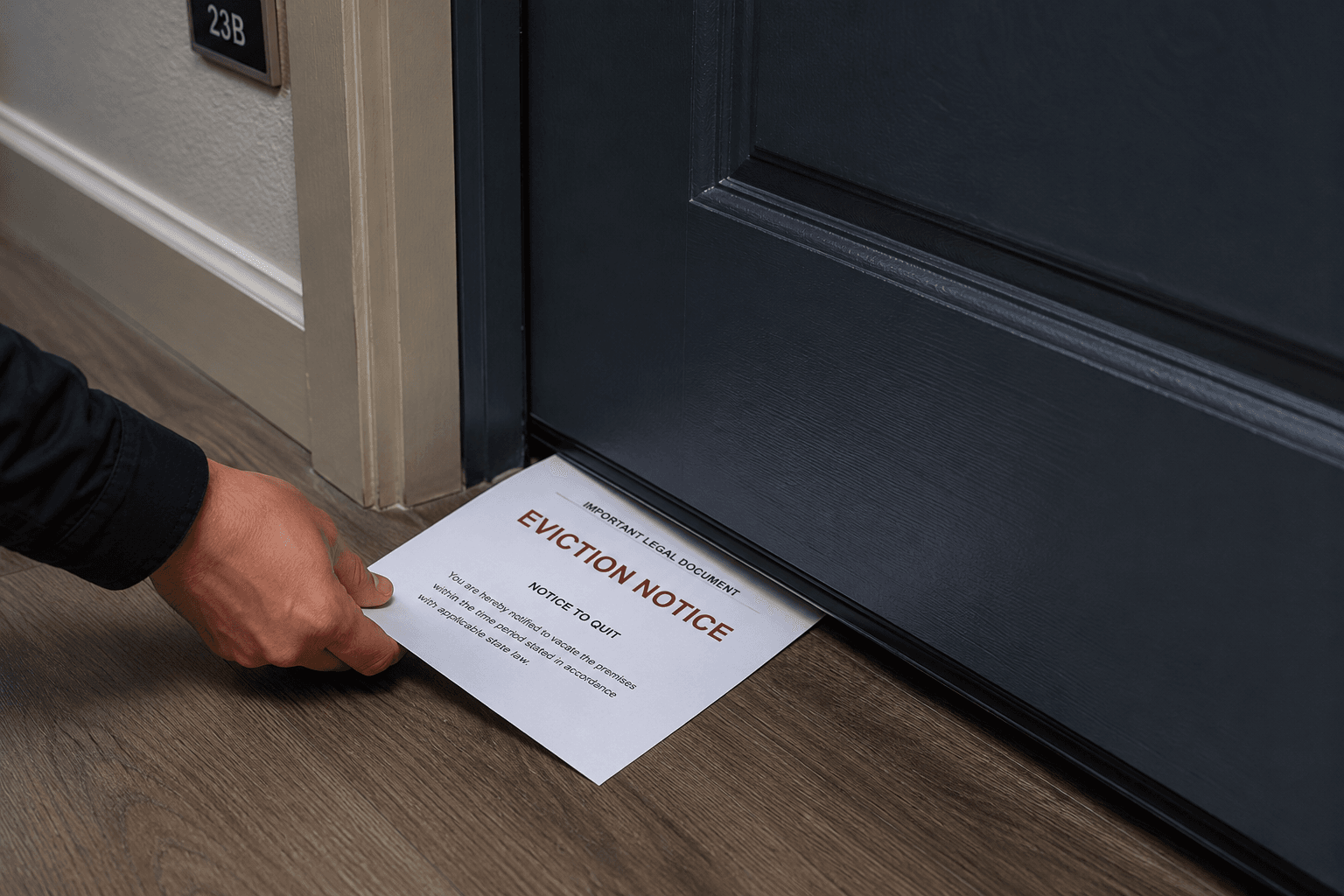

Skipping a notice to enter does not just inconvenience a tenant. It can expose a landlord to trespass claims, harassment liability, and privacy violation lawsuits that surface weeks after the visit. The flip side is equally serious: a tenant who refuses a properly served, valid notice can find themselves facing a notice of lease violation, or, in repeated cases, a formal eviction notice.
Whether you are the one sending the notice or the one receiving it, getting these details right is what keeps a routine visit from turning into a dispute neither side wanted.
What Is a Notice to Enter?
 A notice to enter is a written statement a landlord delivers to a tenant before stepping into an occupied rental unit. It identifies who will be entering, when, and why. A signed residential lease agreement grants the tenant a right to quiet enjoyment of the unit, meaning the landlord cannot walk in whenever it is convenient. The notice gives the tenant advance warning and the opportunity to be present or make arrangements.
According to FindLaw's overview of landlord entry requirements, roughly half of all U.S. states have specific statutes governing residential landlord entry, and even in states without a fixed statutory rule, common law and lease terms fill the gap. In every case, the tenant's right to privacy and quiet enjoyment remains the baseline.
Unlike a residential lease amendment, which modifies the long-term terms of a tenancy, a notice to enter is specific to a single visit. It expires once that visit is complete and must be reissued each time the landlord needs to re-enter.
Create Your Notice to Enter Today
Get a state-ready notice to enter that covers every required field for 2026. Complete in minutes.
What a Notice to Enter Does Not Do
It does not give the landlord open access to the unit. Each entry requires its own notice. A notice served for a plumbing inspection on Tuesday does not authorize the landlord to return on Thursday without issuing a new one.
It does not waive the tenant's right to quiet enjoyment. Even with proper notice, entry must happen at a reasonable hour for a valid, stated reason. A landlord who enters repeatedly without a documented cause may still face a harassment or trespass claim.
It does not replace other formal notices. A notice to enter is not a repair demand, a violation notice, or an eviction document. Those require separate instruments: a notice to repair, a notice of lease violation, or a formal eviction notice.
It does not cover commercial properties under residential statutes. Commercial landlord-tenant law operates under entirely different rules in every state. This document addresses residential rentals only.
What Should a Notice to Enter Include?
A notice missing key details can be challenged by the tenant, declared invalid, or used against the landlord if a dispute goes to court. The fields below are the minimum needed for the notice to hold up in most states.
Landlord and Tenant Identification
Use full legal names for both parties, matching exactly what appears on the residential lease agreement. If a property manager or authorized agent will be the one entering, rather than the landlord personally, include that person's name and their explicit authorization to act on the landlord's behalf. A notice that refers to "someone from the management company" is not adequate.
Property Address
Include the full street address and unit number. For multi-unit buildings this matters: a notice addressed to the wrong unit, or to the building generally without naming the specific unit, may not satisfy the legal requirement.
Valid Reason for Entry
State law generally limits the reasons a landlord can enter an occupied unit. Valid reasons are narrowly defined and vary by state. Vague language like "general inspection" without a specific trigger may not hold up if challenged. Common valid reasons include:
- Requested repair: Performing a repair the tenant requested in writing, such as through a notice to repair.
- Damage complaint: Inspecting the unit following a documented complaint or reasonable suspicion of damage.
- Showing the unit: Showing the unit to prospective tenants or buyers near the end of the lease term.
- Scheduled maintenance: Conducting agreed upon or scheduled maintenance, pest control, or safety inspections.
- Legal process: Complying with a court order or a formal request from law enforcement or fire officials.
Date and Time of Entry
A specific date and time window is required. Something like "sometime next week" is not compliant. California Civil Code Section 1954 sets entry hours between 8 a.m. and 5 p.m. on weekdays absent tenant consent. Florida Statute Section 83.53 sets the window at 7:30 a.m. to 8:00 p.m. Most other states apply a similar business hours standard, and early morning or late evening entries, even with a valid notice, can be challenged as unreasonable.
Delivery Method and Date
Document how the notice was delivered and when. Hand delivery, door posting, certified mail, and electronic delivery through a tenant portal, if the residential lease agreement permits it, are all generally acceptable. If the lease is silent on electronic delivery, a residential lease amendment can formally add that option. Whatever the method, keep a copy of the notice and a record of when it was sent.
Notice to Enter vs. Lease Agreement
Landlords and tenants sometimes confuse these two documents. Both are part of every tenancy, but they serve entirely different purposes. A landlord owns the building, but the tenant holds the legal right to use it in privacy, and the notice to enter is where those two interests formally meet.
Without a valid signed residential lease agreement in place, the landlord's entry rights default to whatever the state's landlord-tenant statutes provide, which in many states is less favorable to landlords than a well-drafted lease would be.
State-by-State Notice Requirements
 There is no single national rule for how far in advance a landlord must notify a tenant. A number of states set no fixed statutory notice period at all, leaving the terms to the lease and the covenant of quiet enjoyment, while others set a specific minimum ranging from 12 hours to 48. Nolo's state-by-state entry chart is a reliable reference for confirming where any specific state falls. Always verify the current requirement for your specific state and city before acting on any figure in this table.
Arizona and Oregon both set fixed statutory windows. Arizona Revised Statutes Section 33-1343 requires at least two days' notice for non-emergency entry, and Oregon Revised Statutes Section 90.322 requires at least 24 hours' actual notice and restricts entry to reasonable times. Delaware, Wisconsin, Texas, and New York are covered in more detail in Nolo's chart above.
Emergency Entry: When No Notice Is Required
Every state carves out an exception for genuine emergencies. If a landlord reasonably believes there is an immediate threat to health, safety, or the property itself, such as a fire, burst pipe, gas leak, or flooding, entry without advance notice is permitted.
This exception is narrow. It does not cover:
- Routine maintenance that could have been scheduled in advance
- Inspections triggered by tenant complaints that have been pending for several days
- Curiosity about the property's current condition
- Responding to a neighbor noise complaint without actual evidence of an immediate threat
A landlord who invokes the emergency exception when no genuine emergency exists loses the protection that exception provides. Courts in several states, including California, have treated repeated unjustified emergency entries as harassment, which carries its own statutory damages exposure.
California: The 24-Hour Standard and What It Actually Covers
California Civil Code Section 1954 sets 24 hours as the presumed reasonable notice period for non-emergency residential entries. The notice must be in writing, state the date and approximate time of entry, state the purpose, and be delivered within the notice window. Entry must occur during normal business hours, generally 8 a.m. to 5 p.m. on weekdays, unless the tenant consents to a different time.
One nuance worth flagging: as the Los Angeles County Department of Consumer and Business Affairs explains, California entry is tied to a specific, documented purpose, such as a repair, a habitability concern, or a showing, rather than general curiosity about the unit's condition.
For landlords showing a unit to prospective buyers, California allows oral notice in limited circumstances, but only if the landlord has sent the tenant written notice within the previous 120 days stating the property is for sale and that oral entry notice may be given. Outside that window, written notice is required. A documented pattern of improper entries can also be used as evidence in an eviction defense, even when the eviction is for an unrelated reason, so consistent written notice protects the landlord as much as the tenant.
Washington: The 48-Hour Rule and Why It Is Stricter Than Most States
RCW 59.18.150 sets Washington's landlord entry rules and requires at least two days' (48 hours') written notice for repairs, maintenance, or inspections. For showings to prospective tenants or buyers, one day's (24 hours') notice is sufficient. The Tenants Union of Washington confirms that the notice must specify the date, time range, and purpose.
Washington also builds in a liability provision that most states lack. Under RCW 59.18.150(7), a landlord or tenant who continues to violate the other's rights under this statute after receiving one written notification citing the date and time of the violation becomes personally liable. That makes documentation of every notice and every entry especially important in Washington.
Florida: 24-Hour Notice and the 7:30 a.m. to 8:00 p.m. Window
Florida Statute Section 83.53 requires at least 24 hours' advance notice before a landlord enters a residential unit for repairs or inspections. Entry must occur between 7:30 a.m. and 8:00 p.m., making Florida's time-of-entry window slightly broader than California's but still explicitly bounded by statute.
Florida landlords have a right to enter at any time, without advance notice, for the protection or preservation of the premises when an emergency exists. The statute also allows entry when a tenant unreasonably withholds consent to a properly requested visit. In practice, that means a landlord facing repeated refusals should document every attempted entry in writing and point to the specific statutory ground being relied on, rather than assume a single method resolves every dispute.
Texas: No Statutory Period and Why That Creates Risk
Texas has no fixed statutory notice period for residential landlord entry. The right of entry and the required advance notice are governed by lease terms and common law, which defaults to approximately 24 hours in practice.
This flexibility creates risk for landlords who rely on loose lease language or skip notice entirely. A tenant who can show the entry was unreasonable, whether the window was too short, the hour was unreasonable, or the reason was not covered by the lease, can pursue a common-law claim for invasion of privacy. The safest approach is to draft a residential lease agreement that specifies a clear notice period, typically 24 hours, and follow it consistently, regardless of the flexibility the absence of a statute may seem to allow.
What Happens If a Tenant Refuses or a Landlord Skips the Notice
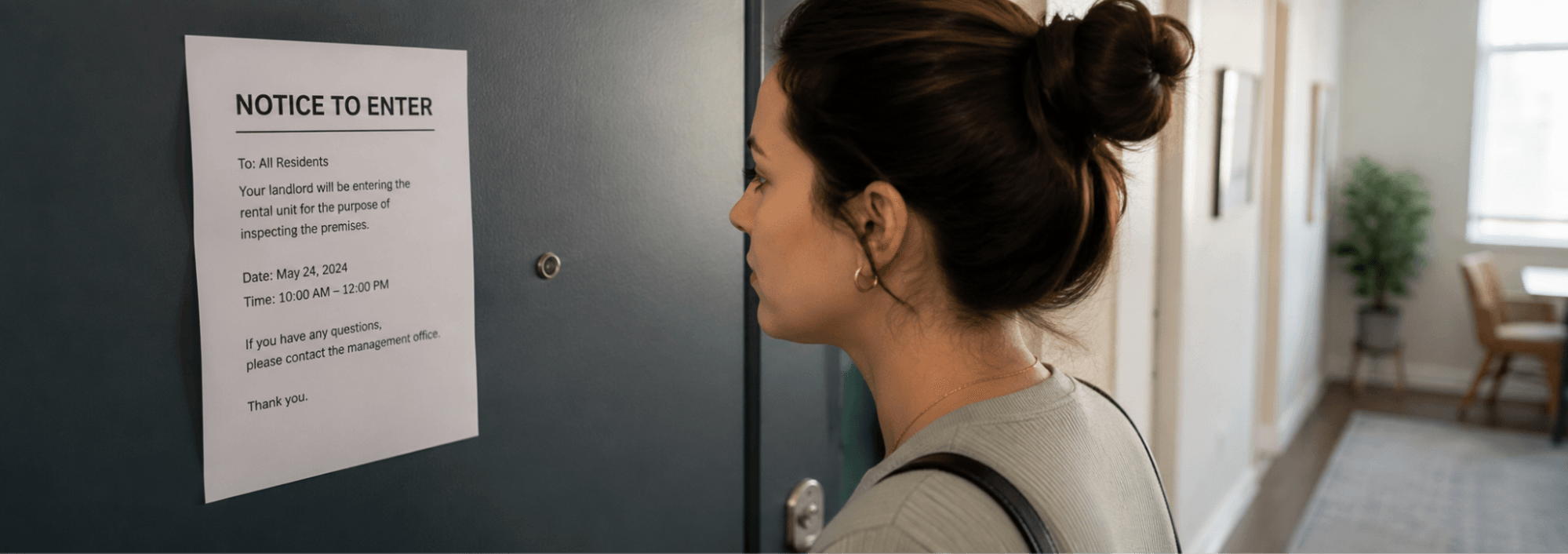
If a Tenant Refuses a Valid Notice
If the landlord has a valid reason and has properly served the notice within the required window, the tenant generally cannot refuse entry. Refusing access can be documented as a lease violation using a notice of lease violation. Tenants cannot unreasonably withhold consent when the landlord has complied with all statutory requirements. Repeated refusal can escalate toward a formal eviction notice if the refusal caused harm or materially interfered with the landlord's ability to maintain the property.
The tenant and landlord can always negotiate a more convenient date or time. A tenant who contacts the landlord promptly to request a different time, rather than simply refusing access, is in a much stronger legal position than one who says nothing and denies entry.
If a Landlord Enters Without Proper Notice
A landlord who enters without a valid reason or without proper notice may be committing trespass, and tenants have the right to pursue a claim for invasion of privacy in small claims court. Depending on the state, the tenant may also be able to:
· File a complaint with the state or local housing authority
· Use the unauthorized entry as grounds to terminate the lease (constructive eviction), typically after documenting the violation in writing to the landlord
· In Washington, pursue damages of up to $100 per violation in small claims court under RCW 59.18.150(7)
· In California (Los Angeles), pursue statutory harassment claims under the Tenant Anti-Harassment Ordinance (TAHO) in addition to a civil privacy claim
Post-Entry Steps: What Each Party Should Do After the Visit

For Landlords
- Keep your copy of the notice permanently: Store the signed notice and delivery confirmation indefinitely. Disputes can emerge months after the visit, and documentation is the first line of defense.
- Complete a written record of what was observed: If the entry was for an inspection, document findings in writing immediately after. If repairs were needed, confirm in writing what was found and what actions will be taken.
- Confirm completed repairs in writing: A brief written confirmation, including the date, what was repaired, and who performed the work, protects both parties from later disputes about whether the issue was resolved.
- If the visit revealed lease violations: Issue a formal notice of lease violation immediately. Do not rely on verbal communication for anything that may need to be enforced later.
For Tenants
- Keep every notice you receive: Retain every notice to enter. If a pattern of overly frequent or harassing entries develops, your file of notices is the evidence that supports your claim.
- Document the unit's condition before and after: Take dated photographs before any inspection or repair entry. If a dispute arises about damage the landlord claims occurred, before-and-after photos establish the baseline.
- Follow up in writing on anything discussed during the visit: If the landlord verbally committed to a repair or commented on the unit's condition, send a brief written summary confirming what was said. This is the kind of detail that determines outcomes later.
- Act promptly if the entry was improper: Contact the landlord in writing immediately after discovering an unauthorized entry. Delay weakens your position if the matter escalates toward a notice to pay rent or quit or eviction proceeding.
Out-of-State Landlords and Remote Management
Landlords who do not live in the same state as the rental property face a practical challenge: they cannot hand-deliver a notice, and they often cannot be present for the entry. Under Colorado's HB25-1090, for example, the professional standard is to confirm that 24-hour notice was given before any vendor or representative accesses a property, and to log that confirmation. That one extra step resolves disputes that would otherwise come down to whether anyone actually told the tenant.
For mailed notices, most states require adding extra days to the notice window to account for delivery time. A hand-delivered notice on Monday complies in California; the same notice mailed on Monday for a Wednesday entry may not. If a property manager or contractor is being authorized to enter, their name and role must appear in the notice explicitly. If the residential lease agreement does not already authorize the property manager by name or title, a residential lease amendment can formally update the document to include that authorization.
Conclusion
Most landlord-tenant relationships do not end in court. The ones that do almost always trace back to a small number of avoidable failures: a notice that was never delivered, a reason that was too vague to be valid, an entry at an unreasonable hour, or a tenant refusal that was never documented. Landlords and tenants both have defined rights in this area, and both sides are exposed when those rights are not respected.
A properly served notice to enter protects both parties. The landlord has documented that the entry was authorized and compliant. The tenant has advance warning and a written record of every visit. When something goes wrong, whether it is a disputed repair, a disagreement about the unit's condition, or a claim of unauthorized access, that paper trail is what determines the outcome.
The notice period, the stated reason, the delivery method, and what happens after the visit all matter. Using a state-specific template that covers every required field eliminates the risk of a technically defective notice creating a far larger problem than the original inspection or repair ever would have.
Create Your Notice to Enter Today
State-specific, covers the correct notice period, a valid reason for entry, and every required field for 2026.
Disclaimer:
360 Legal Forms is not a law firm and does not provide legal advice. This page is for general informational purposes only. Landlord tenant laws vary by state and city and change over time. Consult a licensed attorney or your local housing authority for advice specific to your situation.
Bibliography
[1] State Laws on Landlord's Access to Rental Property
[2] California Code, Civil Code Section 1954
[3] RCW 59.18.150: Landlord's Right of Entry
[4] Florida Statutes Section 83.53: Landlord's Access to Dwelling Unit
[5] Requirements for Landlord Entry
[6] Arizona Revised Statutes Section 33-1343: Access
[7] ORS 90.322: Landlord or Agent Access to Premises
[8] HB25-1090
[9] Tenant Anti-Harassment Ordinance (TAHO)
[10] Landlord Entering Your Unit .