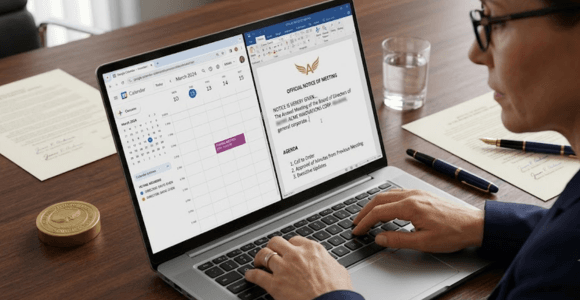
Directors' organizational meeting minutes are the written record of a newly formed corporation's first board meeting, the meeting where initial directors formally adopt bylaws, elect officers, authorize the issuance of stock, and handle other startup tasks that turn a certificate of incorporation into a functioning company. Without this record, a corporation may technically exist on paper but lack the internal documentation that banks, investors, the IRS, and courts expect to see. This meeting is not optional busywork; it is generally the moment your corporation legally "wakes up" and starts operating as intended.
How Directors' Organizational Meeting Minutes Work
When a corporation is formed, someone files a certificate of incorporation or articles of incorporation with the state. That filing creates the corporation as a legal entity, but it does not, by itself, establish bylaws, name officers, or authorize a single share of stock. That work happens at an organizational meeting held shortly after formation.
- Delaware law spells this out directly. Under Delaware law governing the organization meeting of incorporators or directors, once the certificate of incorporation is filed, an organization meeting must be held by the incorporators or by the initial board of directors if directors were already named in the certificate, to adopt bylaws, elect officers, complete any other acts needed to perfect the corporation's organization, and transact any other business. Notice must go out at least two days in advance, in writing or by electronic transmission, unless everyone attends or signs a waiver.
- Most states follow a broadly similar framework, though the exact notice period, whether the meeting can happen within or outside the state, and other mechanics can vary.
- Nobody at the Secretary of State's office reviews or approves your organizational minutes. This is an internal corporate formality, but skipping the meeting or never writing it down can come back to bite you later.
- Quorum and voting rules apply. Delaware's statute on board of directors quorum and voting requirements generally provides that a majority of the total number of directors constitutes a quorum (unless the certificate or bylaws set a different number), and that the vote of a majority of directors present at a quorate meeting is the act of the board. The minutes should clearly show who was present and how each resolution was decided.
Who Needs Directors' Organizational Meeting Minutes and When

- Every newly formed corporation, in most states. If you filed articles or a certificate of incorporation, you generally need an organizational meeting to actually put the company into operation.
- Single-shareholder startups. Even a one-person corporation typically needs to go through the formalities, electing yourself as sole director and officer, adopting bylaws, and authorizing your own stock issuance.
- Multi-founder startups. When there is more than one founder, the organizational meeting is often where ownership percentages, officer titles, and initial control are formally locked in, which can head off disputes down the road.
- Corporations converting from another entity type. A business converting from an LLC or partnership into a corporation typically still needs a first board meeting to adopt bylaws and handle the other organizational items.
- Corporations that skipped the step at formation. If a corporation has been operating for a while without ever holding this meeting, catching up on it sometimes with a ratification resolution covering past actions is generally better late than never.
- Anyone who will need to prove corporate authority later. Lenders, investors, title companies, and licensing agencies often ask to see organizational minutes before extending credit, funding a deal, or approving a business account.
What a Directors' Organizational Meeting Must Accomplish

- Adopting the bylaws, the internal rulebook for how the corporation runs.
- Electing officers (president, secretary, treasurer, and others), titles vary by state and by company.
- Authorizing the issuance of stock: how many shares to issue, to whom, and for what consideration (cash, property, or services).
- Appointing or confirming the registered agent, if not already locked in at formation.
- Authorizing a corporate bank account through a banking resolution naming the bank and the officers authorized to sign.
- Adopting a corporate seal, if one will be used.
- Ratifying the incorporator's pre-incorporation actions, such as paying the filing fee or signing a lease before the corporation legally existed.
- Setting the fiscal year, since the corporation generally needs a defined tax year.
- Addressing the EIN and any tax elections: the corporation generally needs an Employer Identification Number, which can be applied for directly and free of charge through the IRS. If the corporation intends to elect S corporation tax treatment, the board resolution authorizing that election is often adopted here, with Form 2553 generally due no later than two months and 15 days after the start of the tax year the election is to take effect.
What the Minutes Must Include
- A clear header: corporation name, the fact that this is the organizational meeting of the board of directors, and the date, time, and location of the meeting.
- A list of who was present: names of all initial directors present and any absent, and confirmation that a quorum was met.
- Confirmation of notice or waiver: a statement that proper notice was given, or that all directors signed a waiver of notice.
- Election of a chairperson and secretary for the meeting.
- Each decision is written as a formal resolution, generally recorded in "RESOLVED, that…" language rather than as a casual summary.
- Signatures, typically the secretary, and sometimes the chairperson as well.
Details that prevent later disputes or rejected bank/loan applications:
- Exact share issuance details: the exact number of shares issued, to whom, and what was paid for them, not just "shares were issued."
- Complete banking information: the specific bank name and branch, and the names and titles of everyone authorized to sign on the account, matching exactly what the bank will ask for.
- Registered agent details: the registered agent's name and state address, spelled correctly and matching the state filing.
- A stated fiscal year-end date: not left implied or open-ended.
- Consistent officer titles: titles that match what's used everywhere else (contracts, licenses, the EIN application) so there's no mismatch a lender or auditor can flag.
- A ratification clause: covering pre-incorporation expenses and actions, so nobody can later argue the incorporator acted without authority.
Create Your Directors' Organizational Meeting Minutes
Get a complete, attorney-drafted template for directors' organizational meeting minutes that covers every required resolution for your new corporation.
Organizational Meeting vs. Incorporator's Written Consent
Whether written consent is available in place of a meeting and what "unanimous" consent requires can vary by state and by what the certificate of incorporation says, so check your specific state's corporate statute or ask an attorney if you're unsure which route applies to your company.
How to Draft Directors' Organizational Meeting Minutes (Step by Step)
Step 1: Confirm who is holding the meeting.
If initial directors were named in the certificate of incorporation, they generally hold the organizational meeting. If not, the incorporators typically hold their own meeting first to elect the initial board.
Step 2: Send notice or collect signed waivers.
Give each director the required advance notice, generally in writing or electronically, or have every director sign a waiver of notice if you want to skip the waiting period.
Step 3: Hold the meeting and confirm a quorum.
Open the meeting, confirm that enough directors are present to meet quorum requirements, and elect a chairperson and secretary for the meeting.
Step 4: Work through the agenda item by item.
Move through bylaws adoption, officer elections, stock issuance, registered agent confirmation, banking resolution, seal adoption, ratification, fiscal year, and EIN/tax election items.
Step 5: Draft each resolution in formal language.
Write each decision as "RESOLVED, that [specific action]," rather than narrating the discussion.
Step 6: Attach or reference supporting documents.
Note that the bylaws, stock ledger, or banking resolution are attached as exhibits, rather than retyping them into the minutes.
Step 7: Have the secretary sign and date the minutes.
Add the chairperson's signature too if your process calls for it.
Step 8: File the signed minutes in the corporate minute book.
Keep them with the certificate of incorporation, bylaws, and stock ledger, generally for the life of the company.
Do Organizational Meeting Minutes Need to Be Notarized?
Generally, no. Directors' organizational meeting minutes are an internal corporate record, not a document filed with any state or federal agency, so there is typically no legal requirement to have them notarized or even witnessed. What matters in most states is that the minutes are signed by the appropriate officer, usually the secretary, and kept in the corporation's minute book.
That said, notarization isn't prohibited, and some founders choose to notarize anyway as extra insurance. If the validity of a decision made at the organizational meeting is ever challenged later, a notarized signature can make it somewhat harder for someone to claim the document was signed under duress or by someone other than the person named. It's an optional layer of protection, not a legal requirement.
Get Your Directors' Organizational Meeting Minutes Template
Get a complete, attorney-drafted template for directors' organizational meeting minutes that covers every required resolution for your new corporation.
Common Mistakes to Avoid
- Never holding the meeting at all: some founders file their incorporation paperwork and start operating without ever formally adopting bylaws or electing officers, leaving a gap in the corporate record that surfaces during due diligence.
- Vague resolutions: writing "the board approved the stock issuance" without stating who received shares, how many, and what was paid leaves room for disagreement.
- Mismatched officer titles: using one title in the minutes and a different one on bank paperwork or licensing forms can create confusion that slows approvals.
- Forgetting to ratify pre-incorporation acts: if nobody formally ratifies the incorporator's actions, those acts can technically remain unauthorized.
- Skipping the fiscal year decision: leaving the tax year undefined can create confusion when it's time to file the corporation's first tax return.
- Missing the S corp election window: corporations that want S corp tax treatment but miss the IRS filing deadline generally have to wait until the following tax year.
- Losing the signed minutes: minutes that exist only as an unsigned draft don't hold up the same way as a signed, dated original kept in the minute book.
Disclaimer: 360 Legal Forms is not a law firm and does not provide legal advice. This article is intended for general informational purposes only and should not be relied upon as a substitute for professional legal counsel. Corporate laws, including requirements for organizational meetings, notice periods, and quorum rules, vary by state and change over time. For advice specific to your corporation and jurisdiction, consult a licensed attorney.
Bibliography
- Delaware Code Title 8, Section 108 - Organization Meeting of Incorporators or Directors Named in Certificate of Incorporation
- Delaware Code Title 8, Section 141 - Board of Directors: Powers, Quorum, and Voting Rules
- Delaware Code Title 8, Section 132 - Registered Agent Requirements for Delaware Corporations
- IRS - Get an Employer Identification Number
- IRS - Instructions for Form 2553, Election by a Small Business Corporation