
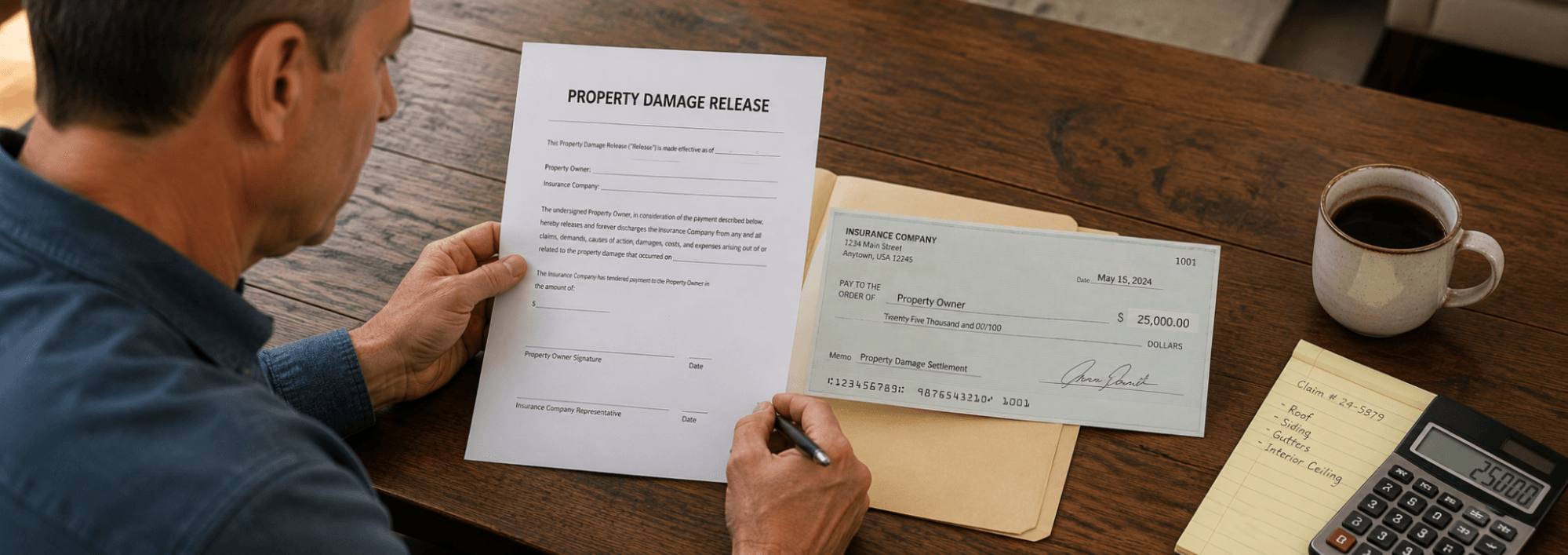
Once you sign a property damage release, you give up the right to ask for another dollar for that same damage, even if you later discover the repair estimate was too low. Insurance companies and landlords use this form to close out a claim for good, which makes it one of the few documents where signing too quickly can actually cost you money.
This guide covers what the form needs to say to hold up, when notarization actually matters, and what to check before you sign, whether you are the one being paid or the one asking someone else to sign it.
What Is a Property Damage Release Form?
A property damage release form is a document in which one party agrees, in exchange for a payment already made or about to be made, to give up any further legal claim against the other party for a specific instance of property damage. It is a release in the legal sense: once signed, it generally bars the signer from suing over that same damage again, even if new problems related to it turn up later.
Common situations where this form gets used include a car accident that only damaged a vehicle or a fence, a tenant accidentally damaging a rental unit, a neighbor's tree falling onto a shed, or any other incident where one party agrees to pay for repairs in exchange for closing the matter completely.
What a Property Damage Release Does Not Do
It does not cover injuries. A property damage release addresses damage to belongings and structures only. If anyone was physically hurt, that requires a separate personal injury release or settlement, and signing a property-only release does not waive an injury claim unless the form explicitly says so.
It does not automatically apply to future or undiscovered damage. Once signed, it closes the book on the damage described in the form, which is exactly why Nolo advises fully assessing the damage before you sign, since a signed release generally cannot be undone just because the repair costs more than expected.
It does not replace a liability waiver. A liability waiver is typically signed before an activity begins, accepting the risk of what might happen. A property damage release is signed after damage has occurred, closing out the incident.
Is a Property Damage Release Legally Valid?
Yes, when it is properly executed. Courts generally treat a release as an ordinary contract, and, as the Cornell Legal Information Institute explains, a valid release requires consideration (something of value exchanged, typically the settlement payment), and must be simple enough for an ordinary person to read and understand. Courts have refused to enforce releases obtained through misrepresentation, fraud, or overreaching, or written in confusing or excessively fine print.
Get Your Property Damage Release Form Today
Document the settlement and close out the claim with a form built for your state.
What Should a Property Damage Release Include?
- The parties: Full legal names of the releasing party and the party being released.
- A description of the incident: What happened, when, and where the damage occurred.
- The property affected: A specific description of what was damaged, such as a vehicle, fence, or rental unit.
- The settlement amount: The exact payment being made in exchange for the release.
- Clear release language: A plain-language statement that the signer gives up any further claim related to this specific damage.
- Signatures and date: Both parties should sign and date the form, with notarization added for higher-value settlements.
Does a Property Damage Release Need to Be Notarized?

Not always. A property damage release is a private contract, and most states do not legally require notarization for it to be enforceable between the parties who signed it. That said, a notary public confirms the signer's identity and that they signed voluntarily, which makes the release harder to challenge later. For any settlement involving a meaningful dollar amount, or when the parties do not know each other well, notarizing the release is standard practice and cheap insurance against a later dispute.
How to Fill Out a Property Damage Release Form
For the Party Being Paid
- Get a full damage assessment first: Get an independent repair estimate before agreeing to a number. Once you sign, that number is final.
- Read the release language closely: Confirm it only covers the property damage described, not any injury or unrelated claim.
- Confirm payment before or at signing: Do not sign based on a promise to pay later unless it is clearly documented in the form.
- Keep a signed copy: Retain your own copy along with the repair estimate and any photos of the damage.
For the Party Paying
- Describe the damage specifically: A vague description can leave the release open to challenge over what it actually covers.
- Document the payment method: Note whether payment is by check, transfer, or repair was completed directly, and keep proof of payment.
- Consider notarization for larger settlements: It adds a layer of protection if the release is ever challenged later.
- Use a mutual release for shared fault: If both sides caused some damage to each other, a mutual release closes out both claims in a single document instead of two one-sided releases.
Property Damage Release in an Insurance Claim
When an insurer is the one paying, it will typically require a signed release before issuing the settlement check, and the National Association of Insurance Commissioners' guide to the claims process notes that settlements often arrive in stages rather than a single check, and that if you disagree with an adjuster's number, you can raise it with your state insurance department's consumer services division before signing anything final. NAIC's consumer guide to auto insurance covers the same process specifically for vehicle damage claims.
Ready to Close Out the Claim?
Put the settlement amount and release terms in writing before any money changes hands.
Conclusion
A property damage release is a short document with a permanent effect: once it is signed, the matter is closed. The party asking for payment should confirm the full extent of the damage before agreeing to a number, and the party paying should make sure the release language actually matches what was agreed to.
Getting a complete damage estimate, describing the incident specifically, and notarizing the form for any significant settlement are what keep this simple document from becoming a costly mistake for either side.
Bibliography
[1] Release — Cornell Law School, Legal Information Institute. Accessed August 2026.
[2] Notarize — Cornell Law School, Legal Information Institute. Accessed August 2026.
[3] Navigating the Claims Process: Recover and Rebuild — National Association of Insurance Commissioners. Accessed August 2026.
[4] A Consumer's Guide to Auto Insurance — National Association of Insurance Commissioners. Accessed August 2026.
[5] Before You Sign a Release In Your Car Accident Claim — Nolo. Accessed August 2026.
Disclaimer: 360 Legal Forms is not a law firm and does not provide legal advice. This page is for general informational purposes only. Release and notarization requirements vary by state and change over time. Consult a licensed attorney or your state insurance department for advice specific to your situation.